Before the Switch: How Rooms Were Lit After Dark
Before electric light, flame shaped where people gathered and worked. Learn how to read the hearth, lamp surfaces and room layout as clues to evening life.
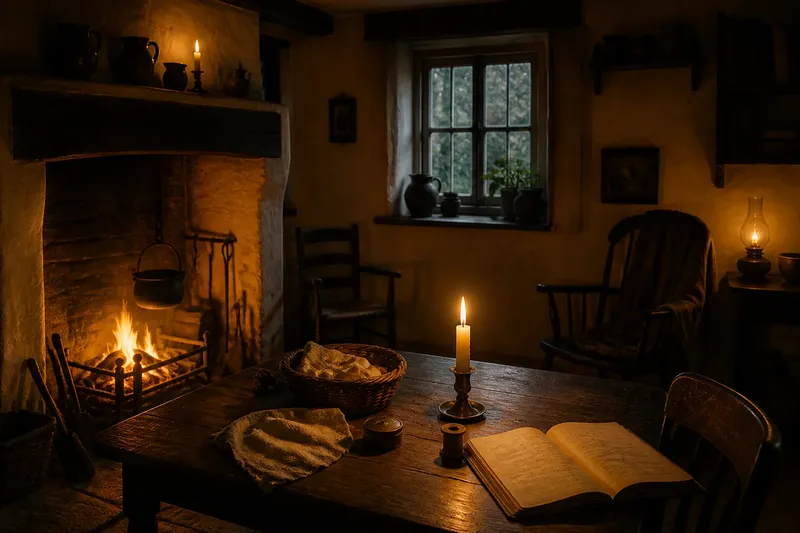
Before electric light, a candle or lamp illuminated a small area, while a hearth could provide both warmth and light. To understand how rooms were used after dark, look at where a flame could stand, where people needed to see their hands and which parts of the room could remain dim.
Historical arrangements varied by household, room and period. A hearth-centred room is a useful way to consider how light could influence domestic life, not a pattern that applied everywhere.
Where did flame draw people together?
A hearth offered a fixed source of warmth and light. Where one was present, people might sit nearby to talk or carry out tasks that needed a clear view. In rooms without a hearth, a candle or oil lamp could light a table or bedside instead.
These sources made some places easier to use than others. Reading, mending and handling small objects called for enough light to see the work; conversation could continue where details were harder to make out. Darker areas might serve for passage or storage, though their use depended on the household.
Flame also needed a stable surface or holder. A lamp could occupy a table or shelf, while a candle needed a suitable holder. The source could not be moved as freely as a modern switch-controlled light, so people often brought a portable lamp closer to a task or moved the task towards the flame.
How did electric light change the room?
Electric lighting could make a wider area visible without placing a flame beside every activity. A ceiling fitting provided general light, while a table lamp could still bring light close to hands and a page. The change did not make every surface equally bright or every task easier; the result depended on the fitting, its position and the room.
It also changed what a room’s arrangement could prioritise. Furniture no longer had to gather around one source of light in the same way, although warmth, convenience and household habits still mattered. The transition took place unevenly, so flame and electric light could coexist in a household or across different rooms.
How can you read a room’s earlier lighting?
Consider clues rather than treating the present layout as proof of a room’s past. A hearth indicates a place where fire could be kept; nearby surfaces may suggest where people could set objects, but furnishings and uses can change over time.
- If a hearth anchors one wall, consider whether it also provided warmth and light; if the room’s history is unclear, treat this as a possibility rather than a conclusion.
- If a table stands near a hearth or lamp-ready surface, ask whether its position supports close work; if not, do not infer that it was placed there for lighting alone.
- If a shelf or side table sits near a work area, check whether it could have held a lamp safely; if its height or position makes that unlikely, look for another plausible surface.
- If a passage is distant from the main light source, consider how someone might have carried a candle or lamp; if the route appears unsuitable, avoid assuming it was regularly used after dark.
- If a corner is now bright, separate present lighting from older evidence; if no historical clue supports its earlier use, leave that question open.
- If a room has both a hearth and electrical fittings, consider that lighting arrangements may have changed in stages; if the sequence cannot be established, avoid assigning a precise order.
What questions help explain rooms lit before electric light?
Why might furniture sit near a hearth?
A hearth could supply warmth as well as light, making nearby seating convenient for several reasons. Its position alone does not establish how every household used the room.
Did electric light make a local lamp unnecessary?
No. A ceiling fitting could provide general visibility, while a lamp near a chair or work surface could direct light where it was needed. The two sources served different purposes.
Were all corners of a room useful after dark?
Not necessarily. A corner could remain dim, be used for storage or become useful when a lamp was brought closer. Its role depended on the room and the people using it.
Can a present-day layout reveal the original arrangement?
It can suggest questions, but it cannot establish the original arrangement by itself. Hearths, old fittings and suitable surfaces are clues to weigh alongside any reliable record of the building.
What does a worked room change look like?
Say you are imagining a household in a single room with a hearth on one wall, a table close beside it, a chair in a darker corner and one new electric ceiling fitting. These are invented starting details, not a claim about a particular historical home.
First, the household switches on the ceiling fitting and checks whether the table can be seen from its current position. If the table is clear enough for shared activity, they move it towards the window wall to open a route through the centre; if it is still too shadowed for close work, they keep it near the hearth or add a local lamp. Next, they place the chair in the corner and check whether a page is legible there. If it is not, they move the chair nearer the table or add a reading lamp.
The resulting arrangement is conditional: the table moves only if the general light suits the activity, and the chair stays in the corner only if its local light is adequate. That sequence shows how a new source could change the choices available without proving that all rooms, or all households, followed the same pattern.
To interpret a room lit before electric light, start with the task and the source: ask where hands needed to be visible, where a flame could stand and which routes required light. The search phrase rooms lit before electric light points to those practical clues, while the room’s particular history determines what they can—and cannot—tell you.